
Standing Water Wrecking Your Orlando Yard? Why a Real French Drain Beats a DIY Downspout Fix
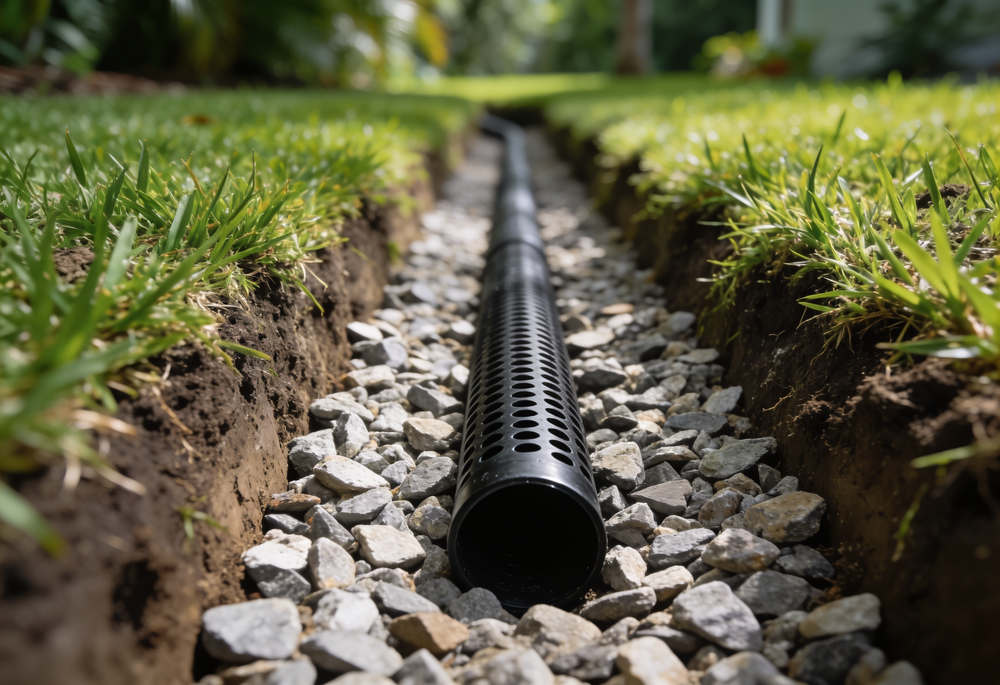
A drain pipe that does not account for grade does not drain anything. It just moves the problem a few feet. A homeowner in the Orlando area installed a pipe tied to the downspouts on the back of the house, certain that routing the water away from the foundation would solve the pooling. It did not. The neighbor's lot sat higher, the yard sloped back toward the house, and every heavy rain still left a pond against the back wall. The pipe was collecting water and sending it nowhere useful. MV Lawn Services and Landscaping pulled the failed install and put in a proper French drain system. The problem was essentially fixed overnight. Call MV Lawn for a drainage assessment or reach the team at (407) 556-5164 if standing water is a recurring issue in your yard.
Why the pipe alone does not fix a grade problem
Homeowners in the College Park area of Orlando, where lots are often narrower and neighbor grades vary significantly from one property to the next, run into this scenario frequently. A standard drain pipe with a downspout connection collects water at a fixed point. If the yard does not slope away from that collection point toward an outlet, the water has nowhere to go. It backs up or pools at the lowest point in the system, which is often right where it started. Adding more pipe in the same configuration does not change the physics. What changes the physics is understanding where the water wants to go and building a drainage path that uses gravity rather than fights it.
The Maitland area, where mature neighborhoods often have established trees that have shifted soil grades over decades, presents a related complication. Root systems change the surface topography over time, creating low spots that did not exist when the home was graded during construction. A yard that drained adequately ten years ago may now have a basin near the foundation that collects every rain event. Treating that problem with a single downspout extension addresses the roof drainage without touching the grade issue that is actually causing the pooling.
In newer construction in Horizon West and similar west Orlando communities, the issue is sometimes the opposite: grading that was done correctly at build but has settled unevenly over the first few years as the soil compacts. Low spots develop along fence lines, at patio edges, and in areas that were disturbed during construction. Those low spots collect and hold water in exactly the spots where it can damage turf, undermine hardscaping, and eventually threaten the foundation if allowed to persist season after season.
What a French drain actually is and why it works differently
A French drain is a perforated pipe surrounded by washed rock, buried in a trench that follows a deliberate path from the problem area to an outlet. The perforations matter: water does not have to find a single entry point at a downspout connection. It enters the pipe anywhere along its length through the perforations, which means water that is pooling in the middle of the yard can be captured and redirected even if the source is not a specific downspout or low point. The surrounding rock filters out sediment while allowing water to move freely into the pipe.
The outlet is where the grade calculation comes in. The trench for a French drain must drop consistently from start to finish so gravity moves the water continuously toward the outlet. A half-inch of drop per foot is a standard working target. If the outlet is not lower than the entry point, the water will not move. Getting that slope right requires looking at the actual site, not just the location of the nearest downspout or the most convenient spot to dig.
Standing water risks beyond a wet lawn
A lawn that pools after rain events is an inconvenience. The risks underneath that inconvenience are more significant. Persistent standing water near a foundation creates hydrostatic pressure against the slab or stem wall, which over time contributes to cracks, moisture intrusion, and soil erosion beneath the structure. Grass that sits in standing water for more than 24 hours after a rain event begins to suffocate at the root level. Florida turf varieties are relatively tolerant of brief saturation during the wet season, but recurring pooling that does not drain within a day is killing the root system incrementally, which is why affected areas tend to thin out and die even when the grass looks acceptable during dry periods.
The irrigation variable that makes pooling worse
Central Florida homeowners with irrigation systems set on fixed schedules sometimes compound pooling problems during the rainy season by watering on days when the ground is already saturated from afternoon storms. The yard receives rain Tuesday evening and then the irrigation runs Wednesday morning before the soil has any capacity to absorb additional water. The result is runoff and pooling from irrigation that would have been fine in the dry season. A rain sensor interrupts the irrigation cycle when meaningful rainfall has already occurred, which reduces overwatering, saves water, and prevents the irrigation system from adding to a drainage problem that is already present. MV handles irrigation installation and sensor retrofits as part of its drainage-related services because the two issues frequently arrive together.
Good landscape design accounts for drainage from the start, which is why properties designed with grade and flow in mind tend to avoid the compounding problems that develop when drainage is treated as an afterthought. If your Orlando yard has a recurring pooling problem, the assessment is the right first step. Call MV Lawn Services and Landscaping at (407) 556-5164 or request your free drainage assessment from MV Lawn and find out what the grade is actually doing before the next rainy season starts.